Grantee Spotlight: Jennings County Historical Society
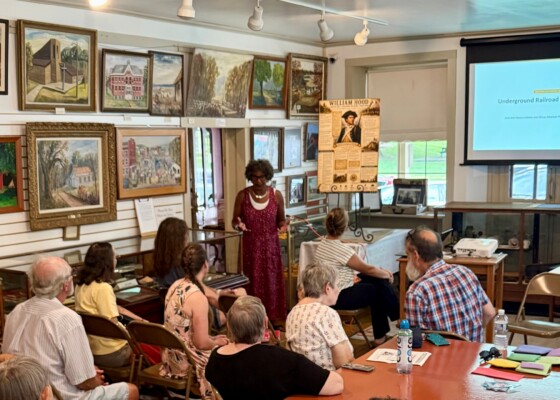
October 22, 2026On a Sunday afternoon in August, more than 30 people crowded into a room at the Jennings County Historical Society, overlooking the courthouse square in Vernon. The group had come to hear a presentation about southeast Indiana’s Black history.
Day in and day out, Indiana Humanities’ grantees and partners are bringing the humanities to life for Hoosiers across the state. From small towns like Jasper to big cities like Fort Wayne, our grantees are creating thoughtful programs, bridging divides, and inspiring Hoosiers to think, read, and talk. As part of our ongoing efforts to uplift the work of our partners, we’re highlighting past and present grantees and sharing their stories of impact.
* * *
On a Sunday afternoon in August, more than 30 people crowded into a room at the Jennings County Historical Society, overlooking the courthouse square in Vernon. The group had come to hear a presentation about southeast Indiana’s Black history.
The program was the second in a three-part series called “Exploring the History and Legacy of Slavery in Indiana,” developed and delivered by Sue Livers, an award-winning historian based in Madison, Indiana. Livers talked about Black settlements in Jennings County, the history of the Underground Railroad in the area, and other topics. Circulating throughout the room, Livers engaged audience members in conversation, bringing stories to life through thought-provoking questions and discussion.
It was this interactive approach that led the Jennings County Historical Society’s Program Committee to invite Livers to Vernon. According to Chris Asher, curator at the JCHS, several historical society members had seen Livers deliver a first-person interpretation of Patsey Harris in nearby North Vernon. For many years, Livers has been interpreting Harris, a Black woman who with her husband Chapman guided many enslaved people to freedom through Madison in the 1840s and 1850s. Members of the JCHS Program Committee met with Livers and asked her to design and present the “Exploring the History and Legacy of Slavery in Indiana” series.
Asher notes that Jennings County is rich in Black history, especially related to the Underground Railroad. The JCHS sponsors annual tours of reputed safe houses along the freedom trail, and Asher says that there’s evidence of tunnels that were used to move enslaved people safely through cellars underneath row houses along what is now Indiana State Road 7 in Vernon. “The participation in these annual tours during the historical society’s Sassafras Tea Festival and Civil War Living History event prompted the society to offer more education regarding Black history and slavery in Indiana,” Asher says. “A wise decision as this series has been very well received.”
About 50 people attended the first event in February, and Livers also presented a program to more than a dozen Boy Scouts, customizing it to align with their interests in nature (she explored how enslaved people used plants for medicinal purposes). The final program in the series takes place November 15. “We have received a great deal of very positive feedback regarding what participants learned, the professional manner in which Sue engages the audience, [and] the heartfelt stories . . . she shares,” says Asher.
Indiana Humanities was pleased to support the series with one of our mini-grants. For Asher, these grants are an important way to help small historical societies “fulfill the mission of presenting, preserving, and documenting local and state history.” Even more, Asher notes, “Indiana Humanities’ ‘stamp of approval’ is a testimony within itself,” demonstrating that programs such as “Exploring the History and Legacy of Slavery in Indiana” provide value to the community.
For information about how Indiana Humanities grants can assist your organization with hosting speaking series and other programs, visit our grants page. You can learn more about the Jennings County Historical Society and its programs on its website, and you can find a brief biography of Sue Livers here.