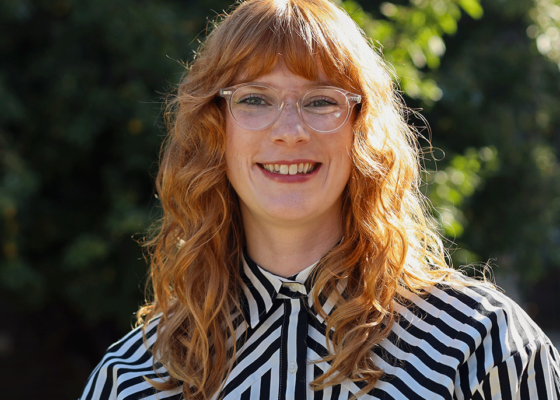
Supporter Spotlight: George Hanlin
October 14, 2026Indiana Humanities thrives because of the generosity of our donors — individuals and corporate supporters alike — who help us bring the humanities to life across the state. Their contributions…

Indiana Humanities thrives because of the generosity of our donors — individuals and corporate supporters alike — who help us bring the humanities to life across the state. Their contributions fuel public programs, fund grants, and provide Indiana communities with meaningful opportunities to think, read, and talk. To celebrate their impact, we’re spotlighting the donors who make our work possible, going behind the gift and sharing their stories.
For our new Supporter Spotlight series, we had the opportunity to connect with George Hanlin — a current staff member as well as a member of our Meredith Nicholson Society, which is a special subset of our donor base that you can learn more about here. We’ve developed a series of five questions for our Society members to better understand their dedication to supporting the humanities.
Why do the humanities matter to you?
I’ve always loved the humanities. As a child, I often had my nose in a book, and reading introduced me to so many fascinating people and places that I otherwise didn’t get to experience in my small Indiana hometown. Also, growing up on the same farm that my family settled in the 1830s, I developed an appreciation for history and storytelling that endures. So the humanities have always been a vital part of who I am.
In addition to enjoying the humanities, I also recognize how vital they are to a healthy society. In a complex world that’s only becoming more complicated, the humanities help us think critically about challenging issues, understand others’ perspectives, add context, and foster meaningful conversations that, I hope, allow us to move forward. We need the humanities now more than ever.
What’s your favorite humanities discipline (and why)?
I love history, especially local history. As noted above, this probably comes from the fact that I have deep roots in my hometown of Pennville, Jay County (and had a grandmother who was very proud of our heritage). At Indiana University Bloomington, I took an Indiana history course with the dean of Hoosier historians, James H. Madison, which also fostered my appreciation for our state’s past. My involvement and interest also grew during the eleven years that I worked in the publications department at the Indiana Historical Society.
What are you feeling curious about lately?
For the U.S. 250th, I committed to reading several books on my shelf that are related to the American Revolution and/or early American history. I haven’t gotten as far as I had hoped, but I’m still making my way through them (I’m currently reading Bunker Hill by Nathaniel Philbrick). I recently took a six-day swing through Viriginia to visit several historic sites, including Jamestown, Williamsburg, Mount Vernon, Monticello, and more. American history, then, has been a big focus of my curiosity latterly.
Otherwise, I tend to be curious about things I happen to come across in my day-to-day life, no matter how mundane. For example, I recently saw on Instagram a post about the 1987 movie Adventures in Babysitting, and I ended up going down a rabbit hole watching the trailer on YouTube and looking up where the stars are today. I find I do this sort of thing a lot—probably more than I should. It’s a big time waster, all for relatively useless knowledge.
What’s your all-time favorite Indiana Humanities experience?
Several years ago, Indiana Humanities hosted an event for our Meredith Nicholson Society members that featured Stuart Hyatt, an Indianapolis resident who records sounds in the field (think the Indiana State Fair or Washington Street in Indianapolis) and arranges them into site-responsive music. At the time of the event, Stuart had been recording bats through his work as a National Geographic Explorer. Bats do make noise, by the way, but at high frequencies that humans can’t hear. Stuart was able to capture the noises with a special recording device and converted them to lower-frequency ranges tuned to human ears.
At the event, Stuart explained his process and played the bat sounds for us, which translated into a series of clicking noises. After his talk, he had a sextet play a musical composition that he arranged using the clicking bat sounds as percussion while a poet read a piece she wrote about bats. The parlor of the Nicholson House, Indiana Humanities’ headquarters, served as the setting for the performance, and it was dimly lit by candles, adding to the atmosphere. The piece lasted only about five minutes, but it was magical, and the audience was mesmerized. It was one of the most creative and engaging events we’ve hosted, and I think most of us in attendance understood just lucky we were to be part of such a marvelous evening.
Why is it important to you to support Indiana Humanities as someone who already serves the organization as a staff member?
I’m a strong advocate for philanthropy, and I think it’s important to support organizations in whose mission you believe. I value the work that we do at Indiana Humanities, and I know that it provides tremendous benefit to Hoosier communities. Even though I work here, I still want to support the organization through financial gifts, and I’m honored to do so.